 The facts, no longer seriously in dispute, are stark. The US went to war over Iraq because of oil and to assure themselves of a platform for control of the Middle East region, as set out in the Project for the New American Century document published for the Bush election team in September 2000. As we now know from Bush’s first Treasury Secretary O’Neill, that was was planned from the first days of the Bush Administration. Then 9/11 simply provided the pretext for launching it.
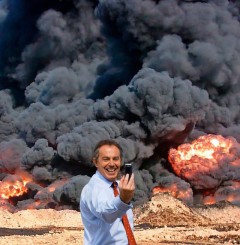
The UK went to war over Iraq because President Bush wanted British support. At the Crawford summit in April 2002 Blair in effect committed to providing that, publicly pledging to stand shoulder to shoulder with President Bush. From that point on, the assessment of intelligence data conflated analysis into advocacy in order to find a rationale for the war that had alreadcy been decided on for other reasons.
The key point is that, in the evidence put together in the crucial 5 months from the Crawford summit up till the publication of the September dossier to justify the war, we now know that all the specific data were flawed:
Anyone who reads appendix B of the Butler report, which is well set out, can see step by step how the process of massaging and accretion steadily accumulated until we were finally told in the September dossier that Saddam’s WMD programme was “active, detailed and growing”, and that the intelligence on which the judgement was based was “extensive, detailed and authoritative”, despite Blair having been told a month before by the UK intelligence community that: “We know little about Iraq’s chemical and biologival weapons work since late 1988″.
The first great issue therefore is accountability in regard to Blair’s judgement, his deceitful presentation, and over-eagerness to take this country into a war on grounds that far exceeded the available evidence to justify it. One cannot take a country into a war under false pretences and then proclaim, as Butler does, that nobody can be held responsible.
I believe there are two issues on which those responsible must be held to account:
As for Iraq itself, it remains a bitterly divided and violent country. It’s not only the hundreds of thousands of dead and at its height the 4 million refugees, but after 9 years of US and British occupation thousands are still tortured and imprisoned without trial, health and education has dramatically deteriorated, the position of women has gone horrifically backwards, trade unions are effectively banned, Baghdad is still divided by checkpoints and blastwalls, electricity and water supplies have all but broken down, and people pay with their lives for speaking out.
In the longer term the war has undermined the moral standing of the US and UK. It generated an al-Qaeda presence in Iraq and beyond that has not been there before. And it has sent a clear message, which has emboldened Iran and North Korea, that the only way to deter blackmail and attack from the US was indeed to acquire WMD. It could even be said that the greatest WMD were those wielded by the Americans – the systematic demolition of Fallujah, the US-led massacres at Haditha, Mahmudiyah and Balad, and the biggest refugee crisis in the Middle East since the ethnic cleansing of Palestine in 1948.
The first is that in any such future scenario the House of Commons vote must be taken, not on the very eve of war when with 45,000 British troops already deployed in the field it was virtually impossible to draw back, but rather at a much earlier stage when war was first being seriously contemplated, and in addition at that stage the documentation purporting to justify war must be fully disclosed to the House before the vote.
The second lesson is that Blair’s power and wilfulness brazenly overrode normal democratic procedures in a manner that must never be allowed to recur:
In an interview in December 2009 he was asked: “If you had known then that there were no WMDs, would you still have gone on?” to which he replied “I would still have thought it right to remove him” (i.e. Saddam). To that end he even colluded with what his own head of MI6, Sir Richard Dearlove, said in July 2002, 8 months before the war, that “intelligence and facts were being fixed round the policy”.
It is that background of the contumacious wilfulness and high-handedness of a Prime Minister dragging this country virtually single-handedly into war that makes it the duty of this House to set down the inviolable conditions to prevent any such catastrophe ever happening again. That must at the very least embrace unquestionable compliance with UN Resolutions, a clear and unwhipped vote of the Commons long before any envisaged hostilities, and full disclosure of all relevant evidence before that vote.
This is based on the speech made in the House of Commons debate on the Iraq war yesterday.
http://www.leftfutures.org/2013/06/iraq-ten-years-on-lessons-still-not-learnt/#more-15586
Blair’s deceit
The decision having been made to go to war, Whitehall provided a briefing that any rationale depended on being able to show incontrovertible evidence of ‘large-scale’ activity by Iraq in weapons of mass destruction (WMD). However, because the UN inspectors left Iraq in 1998, the evidence was almost non-existent. The CIA admitted that its resources on Iraq were ‘thin’, and the UK’s Joint Intelligence Committee had already concluded in March 2002 that intelligence on Iraq’s WMD and ballistic programmes was ‘sporadic and patchy’.The key point is that, in the evidence put together in the crucial 5 months from the Crawford summit up till the publication of the September dossier to justify the war, we now know that all the specific data were flawed:
- The inventory of chemical and biological weapons and weapons parts that Blair presented to the House dealt with weapons unaccounted for since the first Gulf War 12 years before. They were not presented as weapons unaccounted for, however; they were presented as weapons that were believed definitely to be currently possessed by Saddam.
- The 45-minute claim referred to battlefield nuclear weapons, but the impression was given that the threat went much wider. Accordingly when it was reported thus, no attempt was made to correct the misreporting despite the belief that it was wrong.
- The claim that Iraq tried to buy 500 tonnes of yellowcake – a requirement for nuclear fission – fromNiger was still included in the dossier, despite the fact that it was known that a visit made to Niger by a former US ambassador to that country had confirmed 6 months before that the claim was completely bogus.
- Blair claimed to the House on 25 February 2003 – and I think this is very important, yet has had virtually no attention – that the defection of Hussein Kemal, Saddam’s son-in-law, in 1995 had revealed “the offensive biological weapons and the full extent of the nuclear programme”. But as we now know from a Newsweek exclusive a few weeks later, what Hussein Kemal actually said in his de-briefing was exactly the opposite: “all weapons – biological, chemical, missile, nuclear – were destroyed”.
Anyone who reads appendix B of the Butler report, which is well set out, can see step by step how the process of massaging and accretion steadily accumulated until we were finally told in the September dossier that Saddam’s WMD programme was “active, detailed and growing”, and that the intelligence on which the judgement was based was “extensive, detailed and authoritative”, despite Blair having been told a month before by the UK intelligence community that: “We know little about Iraq’s chemical and biologival weapons work since late 1988″.
The first great issue therefore is accountability in regard to Blair’s judgement, his deceitful presentation, and over-eagerness to take this country into a war on grounds that far exceeded the available evidence to justify it. One cannot take a country into a war under false pretences and then proclaim, as Butler does, that nobody can be held responsible.
Failure of accountability
The most striking characteristic of the Butler report is the disjunction between analysis and judgement. It catalogues a litany of failures and then pulls all its punches by declaring that in effect no-one is to blame. George Tenet was sacked as head of the CIA for intelligence failures over Iraq, but John Scarlett who was responsible for exactly the same intelligence failures in this country, is still recommended by the report for promotion, despite all the damning evidence to the contrary. It is a very British Establishment charade but, as an exercise in accountability which is what is needed, it is utterly unacceptable.I believe there are two issues on which those responsible must be held to account:
- The presentation of the evidence that persuaded the House to agree to war. Being sinuous with the truth may not be lying, but it is certainly not open or honest. Presenting a seriously misleading account of the facts may not be lying, but it is not truthful or straightforward either.
- The framework of governance that allowed the decision to go to war to be taken. On that point we still await the final decision and recommendations of the Chilcot report which has been going now 4 years and their report is already far too long delayed.
The consequences of the war
A second fundamental dimension of this whole saga is clearly: what did this war achieve in the long-term? At this tenth anniversary it has been said that the US won the war, Iran won the peace, and Turkey won the contracts. But did the US win the war? At a cost of over £1 trillion – which Joseph Stiglitz, a former member of the Presidential Economic Council puts at twice that level – and a death toll of 4,500 US troops, 32,000 wounded and thousands still struck down with post-traumatic stress disorder, what did the US achieve? They completely failed to anticipate the insurgency which eventually forced them out. After all the wasted blood and treasure they were left with the one result they were desperate to prevent – a Shia autocracy in Iraq reinforcing a a resurgent Shia Iran. And even the US goal of securing control of the enormous Iraqi oil reserves, second only to Saudi Arabia’s, they were forced to forego. If one had to pinpoint the moment when the US lost its unipolar power as the world’s hegemon, it must surely be the total disaster of the Iraq war.As for Iraq itself, it remains a bitterly divided and violent country. It’s not only the hundreds of thousands of dead and at its height the 4 million refugees, but after 9 years of US and British occupation thousands are still tortured and imprisoned without trial, health and education has dramatically deteriorated, the position of women has gone horrifically backwards, trade unions are effectively banned, Baghdad is still divided by checkpoints and blastwalls, electricity and water supplies have all but broken down, and people pay with their lives for speaking out.
In the longer term the war has undermined the moral standing of the US and UK. It generated an al-Qaeda presence in Iraq and beyond that has not been there before. And it has sent a clear message, which has emboldened Iran and North Korea, that the only way to deter blackmail and attack from the US was indeed to acquire WMD. It could even be said that the greatest WMD were those wielded by the Americans – the systematic demolition of Fallujah, the US-led massacres at Haditha, Mahmudiyah and Balad, and the biggest refugee crisis in the Middle East since the ethnic cleansing of Palestine in 1948.
What we should learn
The third consideration lies in the lessons that should be drawn from this disaster.The first is that in any such future scenario the House of Commons vote must be taken, not on the very eve of war when with 45,000 British troops already deployed in the field it was virtually impossible to draw back, but rather at a much earlier stage when war was first being seriously contemplated, and in addition at that stage the documentation purporting to justify war must be fully disclosed to the House before the vote.
The second lesson is that Blair’s power and wilfulness brazenly overrode normal democratic procedures in a manner that must never be allowed to recur:
- He made the commitment to go to war at Bush’s Crawford ranch ten months beforehand without any prior consultation with anybody else.
- He regularly told Parliament right up to the very start of the war that no decision had been taken, when clearly an unstoppable momentum had already deliberately been built up.
- He leant heavily on his Attorney General between 7th and 17th of March to induce him to change his warning that the war could not be legally justified.
In an interview in December 2009 he was asked: “If you had known then that there were no WMDs, would you still have gone on?” to which he replied “I would still have thought it right to remove him” (i.e. Saddam). To that end he even colluded with what his own head of MI6, Sir Richard Dearlove, said in July 2002, 8 months before the war, that “intelligence and facts were being fixed round the policy”.
It is that background of the contumacious wilfulness and high-handedness of a Prime Minister dragging this country virtually single-handedly into war that makes it the duty of this House to set down the inviolable conditions to prevent any such catastrophe ever happening again. That must at the very least embrace unquestionable compliance with UN Resolutions, a clear and unwhipped vote of the Commons long before any envisaged hostilities, and full disclosure of all relevant evidence before that vote.
This is based on the speech made in the House of Commons debate on the Iraq war yesterday.
http://www.leftfutures.org/2013/06/iraq-ten-years-on-lessons-still-not-learnt/#more-15586

